Get started
Trading & Financial
Oct 14, 2026
Comoros Forex Broker Payment Processing: Card Deposits for Mwali (MISA) Licensed Brokers
Why MISA-licensed Comoros brokers struggle with payments, and how to accept card and wallet deposits that convert.
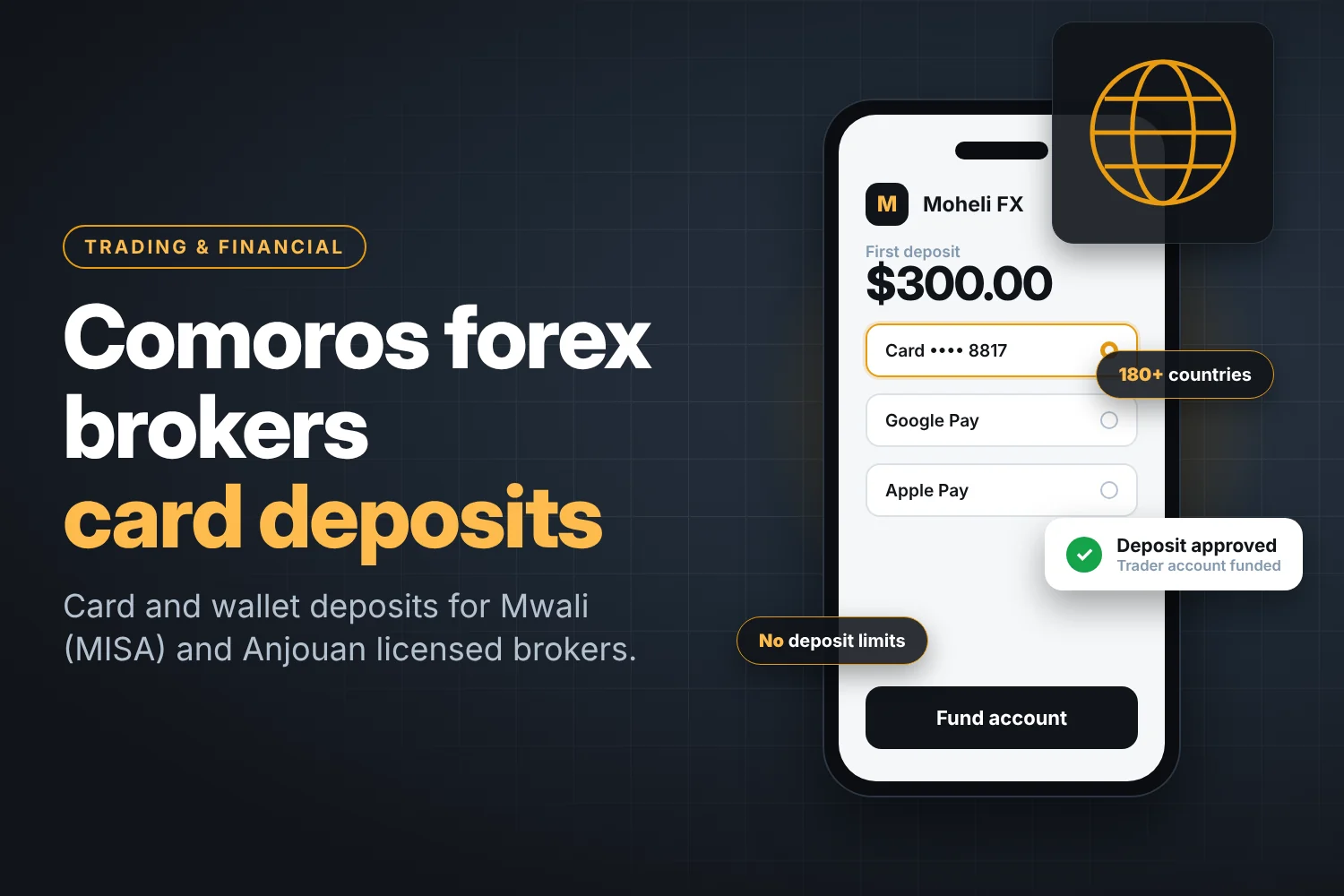
Comoros forex broker payment processing is the part of the launch plan that most MISA-licensed brokers underestimate. The licence from the Mwali International Services Authority arrives in a few weeks, the platform vendor accepts it, the liquidity provider accepts it, and then the first three payment providers decline the application without explanation. This article explains why Comoros forex broker payment processing is harder than the licence itself, what an acquirer sees when it reviews a Mwali company, and how a Comoros broker can accept card, Apple Pay and Google Pay deposits from traders worldwide with no deposit limits.
What a Comoros (Mwali) forex licence is
The Union of the Comoros is made up of three islands, and two of them run their own offshore licensing authorities. Mwali (also written Mohéli) has the Mwali International Services Authority, usually shortened to MISA. Anjouan has the Anjouan Offshore Finance Authority. When brokers say they hold a "Comoros forex licence", they almost always mean the MISA International Brokerage and Clearing House Licence issued to a Mwali International Business Company.
The attraction is obvious. The licence is fast, often issued within three to six weeks of a complete file. It is cheap compared with Seychelles or Mauritius. There is no corporate tax on foreign-sourced income, and the licence permits brokerage activity in forex, CFDs and other instruments for an international client base. In 2024 alone, more than a hundred brokers registered under MISA, and the number has kept growing as St Vincent and other older options became less usable.
The weakness is recognition. MISA is a light-touch offshore authority, and the Central Bank of the Comoros has publicly questioned its standing to issue financial licences. That does not stop the licence from working with platform and liquidity vendors, but it does shape how banks and payment processors react.
Why Comoros forex broker payment processing gets declined
An acquirer reviewing a Comoros broker applies the same policy filters it applies to every trading business, and a Mwali company trips all of them.
| Filter | What the acquirer sees | Outcome |
|---|---|---|
| Merchant category | Forex and CFD trading | High-risk by policy |
| Jurisdiction | Comoros IBC with a MISA licence | Not recognised by major regulators |
| Supervision | No oversight comparable to a Tier 1 or mid-tier regulator | Treated as effectively self-regulated |
| Client base | International, often emerging markets | Higher fraud screening cost |
| Reputation | Frequent association with broker complaints | Brand risk for the acquirer |
Most processors stop at the second row. The application is declined on jurisdiction and category before the trading conditions, deposit sizes or dispute history are ever examined. The few providers that do accept Comoros brokers often compensate for the perceived risk with a payment flow that hurts conversion: a redirect to an unfamiliar third-party page, deposit caps that force traders to split payments, or in some cases a crypto step in front of the deposit.
For the broker, this means a large share of the traders recruited by its IB network never complete a first deposit.
Comoros forex broker payment processing with Novupay
Novupay provides high-risk merchant accounts and fiat payment processing for forex and CFD brokers, and brokerages licensed in Comoros are evaluated on the business rather than declined on the address. The full overview is on the Forex & CFD Brokers payment processing page. In practical terms, a MISA-licensed broker gets the following.
- Forex and CFD brokers licensed in Mwali or Anjouan accepted as a deliberate policy, not as a one-off exception
- A checkout on the broker's own cashier with no redirect to a third-party page
- No maximum per deposit and no daily or monthly cap
- Card, Apple Pay and Google Pay as standard, with local payment methods available on request
- Coverage across more than 180 countries, with sanctioned markets excluded
- A 95% card approval rate, against roughly 70% on competing high-risk solutions
- Settlement in crypto or fiat, chosen per request
The trader experience is a normal card checkout on the broker's own cashier, with no redirect to a page the trader has never seen before.
The conversion argument for a Comoros broker
Comoros brokers usually run lean marketing budgets and rely heavily on introducing brokers and affiliate traffic. Every trader who reaches the cashier has already cost money to acquire, which makes the completion rate at the cashier the most important number in the funnel.
Competing flows lose traders at two points: the redirect to a third-party page and the issuer decline. Novupay removes the first and keeps the second to a minimum. The illustrative comparison below assumes 100 traders each attempting a $300 first deposit.
| Stage | Competing high-risk flow | Novupay |
|---|---|---|
| Traders reaching the cashier | 100 | 100 |
| Drop-off at third-party redirect page | 10 to 20 | 0 |
| Issuer declines on remaining attempts | ~30% | ~5% |
| First deposits completed | roughly 56 to 63 | roughly 95 |
| Funded volume from $300 attempts | $16,800 to $18,900 | ~$28,500 |
The competing-flow figures are ranges rather than a single benchmark, but the pattern holds across brokers: the same traffic funds around half as many accounts again through a clean card flow. That is why the comparison a Comoros broker should make is net funded revenue per 100 traders, not the headline rate on a fee sheet.
Chargebacks and rolling reserve
Forex is labelled a chargeback-prone category, and Comoros brokers sometimes assume they will carry a heavy reserve as a result. Chargebacks are part of card payments and no processor can rule them out, Novupay included. In practice, though, disputes are rare for a legitimate business. Disputes come from confusion and unmet expectations; a broker that honours withdrawals, keeps its terms clear and does not push the trader through a stranger's checkout page keeps them low.
Rolling reserve is not applied as a blanket rule to Comoros brokers. Whether one applies is decided case by case on the individual business, and where a reserve is used it can be fixed at a set rate once the evaluation is complete. A MISA licence does not, on its own, decide whether a reserve applies or at what level.
How to get card payments for your Comoros forex brokerage
The approval process is built to give a fast answer.
- Get in touch and provide your website, your incorporation and licensing jurisdiction (Comoros, Mwali or Anjouan) and your target market.
- Novupay comes back quickly on whether it can process for your brokerage.
- A quick KYC and KYB check is run on you and your business. Onboarding takes under 24 hours once the required information is provided.
- Your team integrates the checkout into your cashier with the help of the Novupay team.
- You go live and start accepting card, Apple Pay and Google Pay deposits from your traders.
Because Novupay processes pay-ins only, your existing withdrawal arrangements stay in place.
Mwali versus Anjouan, and versus the other offshore options
Brokers comparing the two Comoros authorities, or weighing Comoros against Seychelles and Vanuatu, usually want to know whether a different licence would make payments easier. The differences are mostly about cost, speed and how vendors treat the licence rather than about how a mainstream acquirer reacts.
| Option | Authority | Typical timeline | Licence character | Mainstream processor reaction |
|---|---|---|---|---|
| Comoros (Mwali) | MISA | 3 to 6 weeks | Light-touch offshore brokerage licence | Usually declined on category and jurisdiction |
| Comoros (Anjouan) | AOFA | Similar, sometimes faster | Light-touch offshore licence | Usually declined on category and jurisdiction |
| Seychelles | FSA | Several weeks to months | Securities dealer licence, modest capital | Declined on category, occasional exceptions |
| Vanuatu | VFSC | Several weeks to months | Dealer licence, modest capital | Declined on category, occasional exceptions |
| St Lucia | IBC registry | About 1 week | Registration plus legal opinion | Usually declined on category and jurisdiction |
A Comoros broker does not have to upgrade its licence to solve payments. It needs a provider that works with the forex category on purpose and evaluates a Mwali or Anjouan company on its merits. Novupay does that across all of these jurisdictions.
Further reading on Comoros forex licences and offshore broker payments
The links below explain the MISA licensing framework, the difference between the Mwali and Anjouan authorities, and how Comoros compares with the other offshore forex jurisdictions on cost, timeline and, most importantly, payment and banking access. They are useful context for any broker researching Comoros forex broker payment processing before or after obtaining a licence.
- Comoros forex licence 2026: costs, requirements and step-by-step process – an overview of the MISA and AOFA routes, what each authority covers and what the application involves.
- Comoros forex licence: a comprehensive guide to Mwali (MISA) regulation – detail on the International Brokerage and Clearing House Licence, IBC formation and ongoing obligations.
- Comoros forex licence overview and the recognition question – a candid look at how the Comoros licence is perceived and why payment options are harder to obtain.
If you run a Comoros-licensed brokerage and want card deposits that convert, tell us about your business on the Forex & CFD Brokers page and we will confirm what we can do for you.
FAQ
Can a MISA-licensed Comoros broker get a merchant account for card deposits?
Yes. Novupay evaluates Comoros forex brokers on the business itself. Share your website, jurisdiction and target market for a fast answer.
Does it matter whether my licence is from Mwali or Anjouan?
Both are evaluated on the same basis. Mention which authority issued your licence when you get in touch.
What payment methods can my traders use?
Card, Apple Pay and Google Pay as standard. Local payment methods are available on request.
Are there deposit limits?
No. There is no maximum per transaction and no daily or monthly cap.
How fast is onboarding?
Under 24 hours once the required information has been provided.
How do I receive my money?
In crypto or in fiat, chosen per request.