Get started
Gambling & Betting
Oct 26, 2026
Panama Online Casino Payment Processing: Card Deposits for JCJ-Licensed Operators
How JCJ-licensed Panama casinos accept card, Apple Pay and Google Pay deposits as the 2026 player protection law begins.
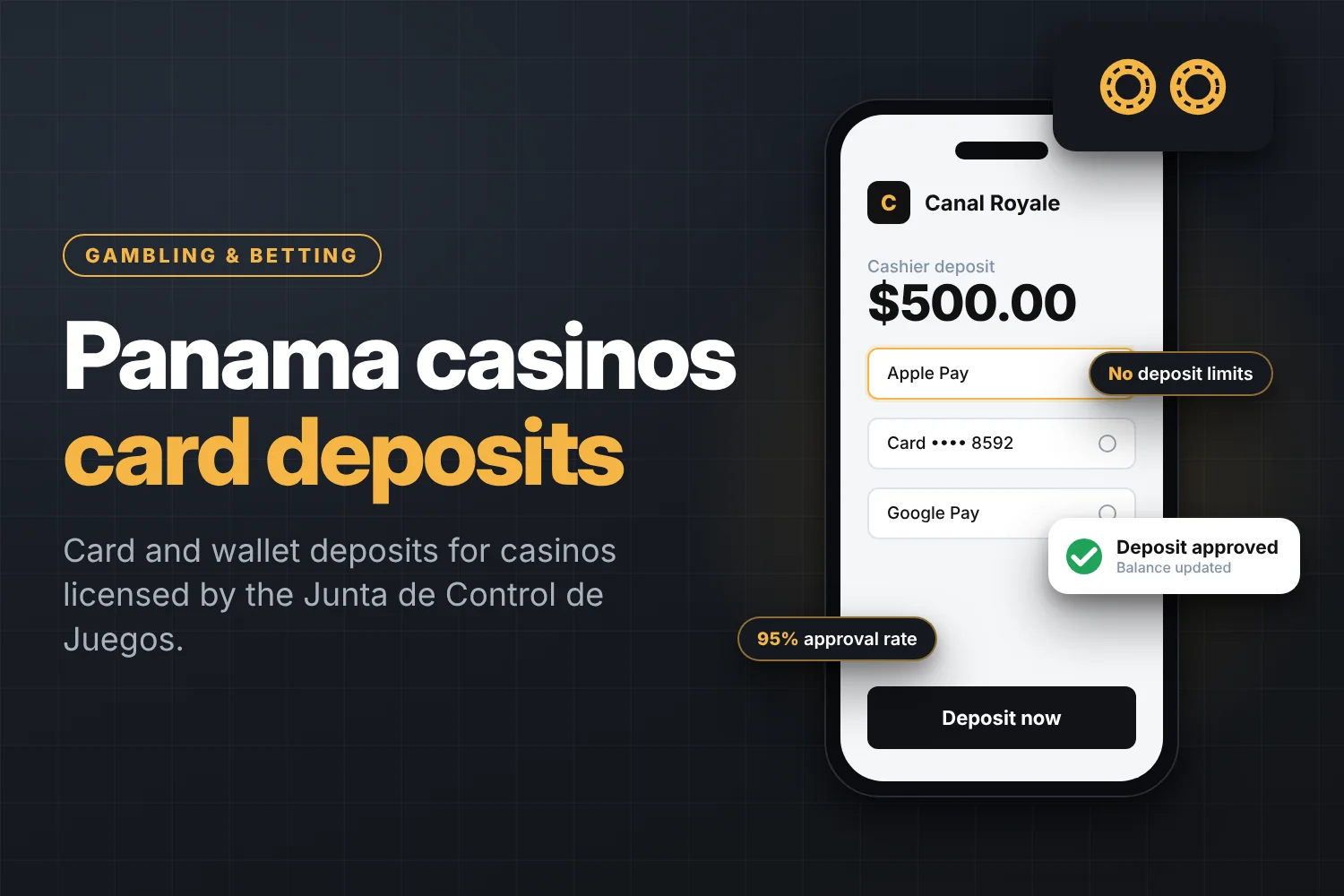
Panama online casino payment processing sits in an awkward place. Panama has licensed online gaming for more than twenty years, its regulator is a real government body, and in 2026 it passed one of the strictest player protection laws in Latin America. Yet a casino holding a licence from the Junta de Control de Juegos is still declined by most mainstream acquirers the moment the word "casino" appears on the application. This guide explains how the Panama licence works, what the 2026 reforms mean for the cashier, and how a JCJ-licensed operator can accept card, Apple Pay and Google Pay deposits from players in more than 180 countries without deposit limits.
How the Panama licence works
Panama's gaming regulator is the Junta de Control de Juegos, usually shortened to JCJ. It was restructured under Decree Law No. 2 of 1998 and began issuing online licences in the early 2000s. That makes Panama one of the older online gaming jurisdictions in the Americas, older than most of the licences operators now compare it with.
The licence is aimed at operators who want a recognisable authorisation without the cost and paperwork of a European regulator. An operator incorporates a Panamanian company, appoints a legal representative resident in Panama and applies to the JCJ for an online casino or online sportsbook authorisation. Online operators pay a tax on gross gaming revenue, and licences are issued for a multi-year term rather than renewed every twelve months.
A reform in 2020 added a further option. Licensees can apply for specific JCJ authorisation to serve players inside Panama, provided they meet local infrastructure requirements. Without that authorisation, the licence is used to serve international players, most of them in Latin America.
| Panama at a glance | Detail |
|---|---|
| Regulator | Junta de Control de Juegos (JCJ) |
| Core legal basis | Decree Law No. 2 of 1998, online licensing since the early 2000s |
| Typical licensees | Online casinos and sportsbooks serving Latin American and international players |
| Local market | Open only with specific JCJ authorisation |
| 2026 change | Law 527 on problem gambling, with new duties for online operators |
What changed in 2026
In March 2026 Panama's National Assembly approved a bill aimed at problem gambling in online casinos, and it became Law 527 when it was published in the official gazette on 28 May 2026. The executive has six months to issue the implementing regulations, so operators are working through the detail during the second half of the year.
The headline duties for online licensees are clear enough.
- Players must be offered voluntary spending limits and time limits.
- Platforms must send automatic alerts when play looks risky.
- Biometric age and identity checks must keep under-18s off the site.
- Online operators face annual audits by the JCJ.
- Fines run from B/.25,000 to B/.100,000, doubling for repeat breaches, with possible suspension or cancellation of the licence.
The law also gives the JCJ power to order telecom and internet providers to block websites, apps, domains and IP addresses offering gambling without a JCJ licence. For a licensed operator that is good news. Competitors that never applied for a Panama licence now face being cut off, and the licence becomes more valuable.
None of this changes how acquirers classify the business, though. A Panama casino after Law 527 is better regulated than before, and it is still an online casino.
Why Panama online casino payment processing is still hard
Mainstream acquirers start with category, not jurisdiction. Online gambling is excluded outright by most of them, so the application stops at the first question. The minority that do accept gambling then ask which licence the operator holds and which markets it serves.
A Panama casino can answer the first question with a real government licence. The second is where the trouble starts. A typical JCJ licensee serves players across Mexico, Colombia, Peru, Chile, Argentina and Central America, plus some European and Asian traffic. To an acquirer that profile means several issuing banks in several regions, a high share of cross-border transactions and a fraud screening cost that most risk teams would rather not take on.
Operators that do find a provider often end up with a flow that leaks deposits. Players are redirected to an unfamiliar third-party page halfway through paying, issuers decline cross-border gambling transactions at high rates, or the provider caps deposit size. Some Panama operators give up on cards and run a crypto-only cashier, which cuts out most of the casual players that Latin American affiliates actually send.
What a JCJ licensee needs from a payment provider
The list is short, but it is rare to find all of it in one place. A Panama casino needs acceptance of online casinos as a deliberate category, evaluation of the operator on its business rather than a decline on jurisdiction, a card checkout that keeps the player inside the cashier, Apple Pay and Google Pay for the many players depositing from a phone, coverage across Latin America and beyond, and no arbitrary cap on deposit size.
Novupay provides high-risk merchant accounts and fiat card processing for online casinos, and JCJ-licensed operators are evaluated on the business itself rather than declined on category or jurisdiction alone. The full overview is on the Online Casinos payment processing page.
The flow is direct fiat processing. A player picks card, Apple Pay or Google Pay in the cashier, enters the details or confirms with a wallet, and the deposit completes. There is no redirect to an unfamiliar third-party page. Card, Apple Pay and Google Pay are standard, and local payment methods are available on request, which matters in a region where many players are used to paying with something other than a card.
Novupay processes pay-ins only. The casino keeps its existing withdrawal rails, whether that is bank transfer, local methods or crypto, and nothing about payouts needs to change. Settlement is in crypto or fiat, chosen by the operator per request.
Deposit limits and the new responsible gaming duties
Novupay places no maximum on a single deposit and no daily or monthly cap for the player. Some Panama operators ask how that sits with Law 527, which requires voluntary spending limits.
The two work at different levels. The absence of a processor cap means a high-value player is never blocked by an arbitrary ceiling set by the payment provider. The voluntary limits required under Law 527 are set by the player inside the casino account and enforced by the casino platform before a deposit request ever reaches the checkout. The operator's responsible gaming controls, alerts and age and identity checks work exactly as before, because they live in the casino's own systems.
This separation is useful in an audit. The JCJ will want to see that limits are offered and respected, and that record sits with the operator rather than being split across a payment provider's rules.
Panama online casino payment processing and conversion
Latin American casino traffic is expensive. Affiliates, streamers and paid media all cost money before a player opens the cashier, so the share of players who complete a deposit decides whether the acquisition spend pays back.
Competing high-risk flows lose players at two points: the redirect to a third-party page and the issuer decline. Novupay removes the first and keeps the second to a minimum with a 95% card approval rate, against roughly 70% on competing high-risk solutions. The comparison below assumes 100 players each attempting a $150 deposit, a typical first deposit for a Latin American casino player. The competing figures are illustrative ranges rather than a single benchmark.
| Stage | Competing high-risk flow | Novupay |
|---|---|---|
| Players opening the cashier | 100 | 100 |
| Lost at third-party redirect page | 10 to 20 | 0 |
| Declined by issuer | ~30% of remainder | ~5% |
| Deposits completed | roughly 56 to 63 | roughly 95 |
| Deposited volume from $150 attempts | $8,400 to $9,450 | ~$14,250 |
The gap widens over time. A player whose first deposit goes through cleanly is far more likely to deposit again, and repeat deposits are where casino revenue is actually made.
Chargebacks and rolling reserve for Panama casinos
Chargebacks are part of card payments and no processor can rule them out, Novupay included. Disputes are rare for a legitimate business that delivers a real product, and a Panama casino that pays winnings promptly, keeps bonus terms clear and runs the responsible gaming tools Law 527 now requires removes many of the usual triggers. A player who stays on the casino's own cashier also has less reason to say "I don't recognise this charge".
Rolling reserve is decided case by case on the individual business. Where a reserve applies, it can be set as a fixed rate once the evaluation is complete. Holding a Panama licence does not, on its own, decide whether a reserve is used.
How to get card payments for your Panama casino
- Share your website, your incorporation and licensing jurisdiction (Panama) and your target markets.
- Novupay comes back quickly on whether it can process for your casino.
- A quick KYC and KYB check is run on you and your business. Onboarding takes under 24 hours once the required information is provided.
- Your own team integrates the checkout into your cashier with the help of the Novupay team.
- You go live and start accepting card, Apple Pay and Google Pay deposits.
Novupay is itself incorporated in Costa Rica, so the Central American context is familiar.
Further reading on Panama gambling regulation and casino payments
The links below cover the 2026 reforms in Panama and what they mean for licensed online operators. They are useful context for anyone researching Panama online casino payment processing or planning how to bring a cashier in line with the new player protection duties.
- Panama approves new gambling law with website blocking powers, player protection measures – a summary of Law 527, the blocking powers and the new obligations for online operators.
- Panama policymakers vote in favour of limiting online gambling market – coverage of the March 2026 bill and the measures it proposed for online casinos.
- Operating in Panama: tax, advertising and licence overview – an operator-focused overview of JCJ licence types, terms and the recent changes.
If you hold a Panama licence and want card deposits that convert, tell us about your casino on the Online Casinos page.
FAQ
Can a JCJ-licensed Panama casino get a merchant account for card deposits?
Yes. Novupay evaluates Panama casinos on the business itself. Share your website, licensing jurisdiction and target markets for a fast answer.
What payment methods can my players use?
Card, Apple Pay and Google Pay as standard. Local payment methods are available on request.
Does Novupay cap deposit size?
No. There is no maximum per transaction and no daily or monthly cap. The voluntary limits a player sets in the casino account under Law 527 are handled by your own platform.
Which countries can players deposit from?
Players in 180+ countries can deposit. Sanctioned countries are excluded.
Can Novupay process player withdrawals?
No. Novupay processes deposits and pay-ins only, so you keep your existing withdrawal rails.
How long does onboarding take?
Under 24 hours once the required information has been provided.